
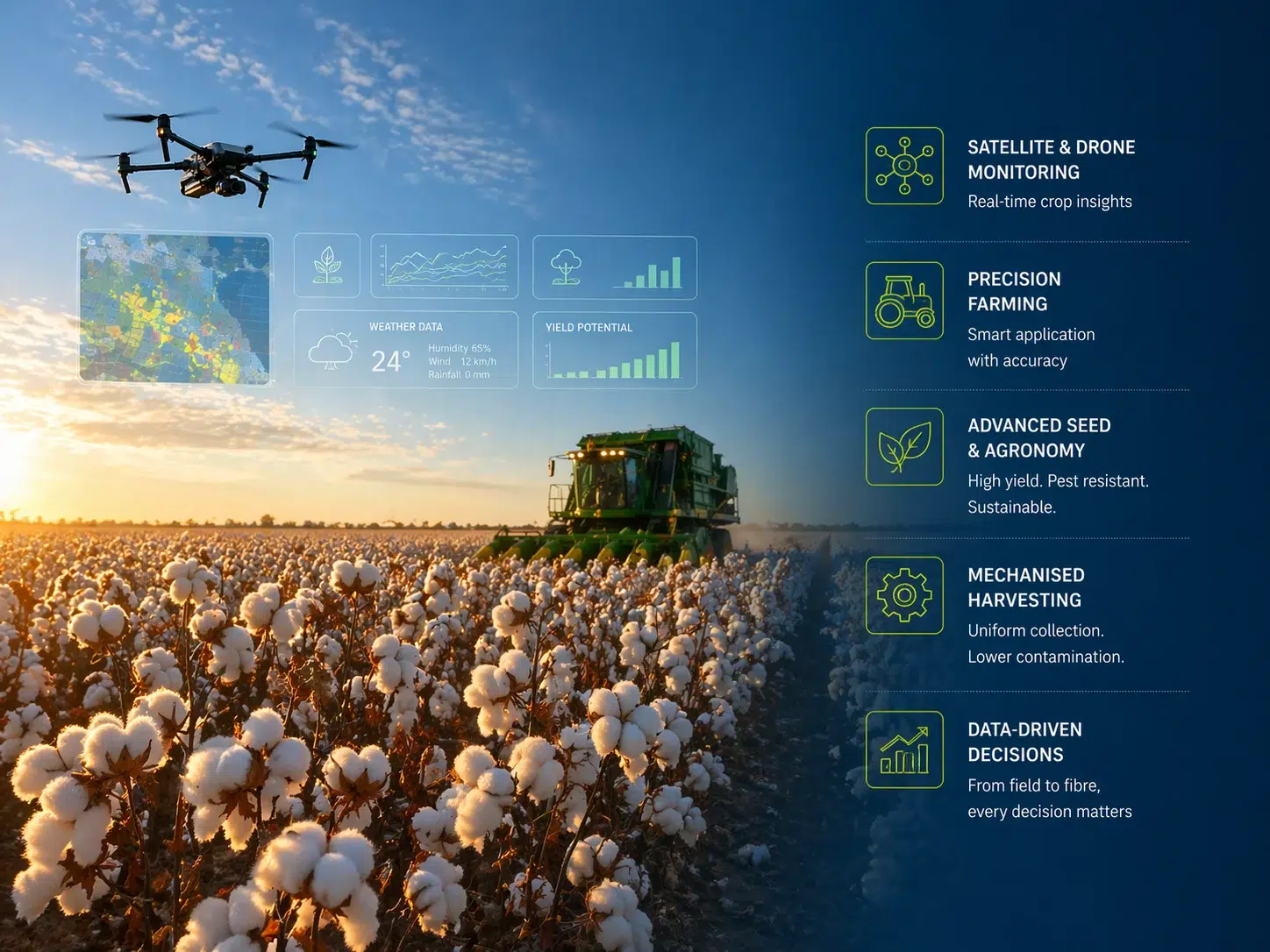
Brazilian cotton has evolved into a system where scale, technology, and discipline operate as a single integrated model. What differentiates Brazil is not just the adoption of advanced tools, but the way these tools are embedded into large-scale, standardised farming operations. Over time, cotton cultivation has shifted from experience-led practices to structured, data-backed decision-making.
This transformation has enabled Brazilian cotton to deliver consistency at scale, aligning with the growing global demand for predictable, traceable, and high-quality fibre. The outcome is a production system where quality is engineered through process control rather than influenced by variability.
Data and Technology at the Core of Farming Operations
Cotton farming in Brazil is built on precision. Large farm sizes require high levels of coordination, and technology enables this control across thousands of hectares. GPS-guided machinery, variable-rate application systems, and automated equipment ensure that inputs are applied with accuracy. Each field is managed based on its specific soil and crop conditions, replacing uniform treatment with targeted intervention.
Satellite imagery and drone-based monitoring provide continuous visibility into crop performance. Combined with soil mapping and weather data, these tools support timely and informed decisions across the crop cycle. Farm operations are increasingly managed through integrated digital platforms that consolidate data from machinery, sensors, and field observations.
This enables:
- Continuous tracking of crop and input performance
- Early detection of variability in yield and pest pressure
- Precise timing of sowing, spraying, and harvesting operations
Mechanised harvesting further standardises output, ensuring uniform fibre collection while reducing contamination. At scale, these systems transform farming into a controlled, repeatable process where outcomes are driven by data rather than variability.
Advancements in Seed and Agronomy
The strength of Brazil’s cotton system is reinforced by continuous innovation in seed development and agronomy. Cotton varieties are bred to suit local climatic conditions, combining high yield potential with resistance to key pests and diseases. The widespread adoption of genetically improved and pest-resistant varieties has reduced dependency on chemical interventions while improving crop stability. Yield levels in Brazil consistently exceed global averages, supported by this strong genetic foundation.
Agronomic practices further enhance system performance. Crop rotation, particularly the soybean–cotton cycle, maximises land utilisation while breaking pest and disease cycles. No-till cultivation helps retain soil moisture and improve organic matter, supporting long-term soil health. Input application is optimised through precision systems, ensuring efficiency in fertiliser and pesticide use. These practices are not isolated interventions but part of a broader, structured approach to sustaining productivity across seasons.
System Strength: Scale, Consistency, and Sustainability
Brazil’s competitive advantage lies in how scale, process discipline, and resource efficiency are integrated into a single operating model. The system is designed to deliver consistent outcomes across large.
1. Quality as a System Outcome
In Brazil, fibre quality is a direct result of how effectively the production system is managed. Standardised practices across sowing, crop management, and harvesting minimise variability before the cotton reaches the gin.
Three structural elements underpin this consistency:
- Fully mechanised harvesting, ensuring uniform fibre collection
- Integrated ginning systems aligned with farm operations
- Bale-level testing and traceability across the supply chain
This alignment ensures that quality is not an isolated outcome but a built-in characteristic of the system.
2. Scale as an Enabler of Efficiency
Brazil’s cotton farms operate at a scale that allows processes to be replicated with precision. With average farm sizes around 4,000 hectares and key regions such as Mato Grosso contributing ~70% of national production, operations are designed for standardisation.
Scale enables:
- Efficient deployment of high-capacity machinery
- Replication of standard operating practices across fields
- Optimised logistics and resource utilisation
This creates a system where efficiency and control reinforce each other, allowing large-scale farming to operate with consistency rather than variability.
3. Sustainability Through Precision
Sustainability in Brazilian cotton is closely linked to how efficiently resources are managed. With over 90% of cotton grown under rain-fed conditions, reliance on irrigation is limited.
Precision technologies ensure that inputs are applied only where required, improving efficiency and reducing excess usage. The increasing adoption of biological pest management further supports soil health and biodiversity.
Traceability systems provide visibility across the supply chain, linking farm practices with downstream requirements. This transparency strengthens confidence among global buyers and aligns production with evolving sustainability expectations.
Conclusion
Brazil’s cotton sector demonstrates how technology, agronomy, and scale can be integrated into a structured production system. Farming operates as a coordinated process where decisions are data-led, execution is standardised, and outcomes are consistently aligned with global quality requirements.
For the industry, this translates into a sourcing ecosystem defined by reliability, transparency, and operational efficiency. As technology adoption continues to deepen, Brazil’s focus remains on strengthening system-level performance, ensuring that scale and precision continue to deliver consistent, high-quality cotton.
To know more, write to us on support@cottonbrazil.com