
Brazil accounts for about 30% of global cotton exports, making it the largest exporter in the world. This leadership position has been built through sustained investment in its institutional framework across the value chain, including mechanised harvesting, structured ginning, and widespread sustainability certification. More than 80% of national production is covered under the ABR (Responsible Brazilian Cotton) program.
As export volumes expanded and Brazil assumed greater responsibility in global supply chains, strengthening governance at the logistics interface became a strategic priority. While fibre quality, scale, and sustainability credentials form the foundation of competitiveness, export reliability increasingly defines long-term trade relationships.
ABR-Log was introduced in 2023, with a clear objective to extend certification principles beyond farm and gin, embedding structured standards at the port stage and completing the governance continuum from production to shipment.
Port-Level Standardisation
Brazil’s cotton exports move through a multi-stage logistics network before reaching international buyers. With exports reaching record levels in recent seasons, coordination across retro-port terminals, inspection bodies, and exporters became central to sustaining reliability at scale.
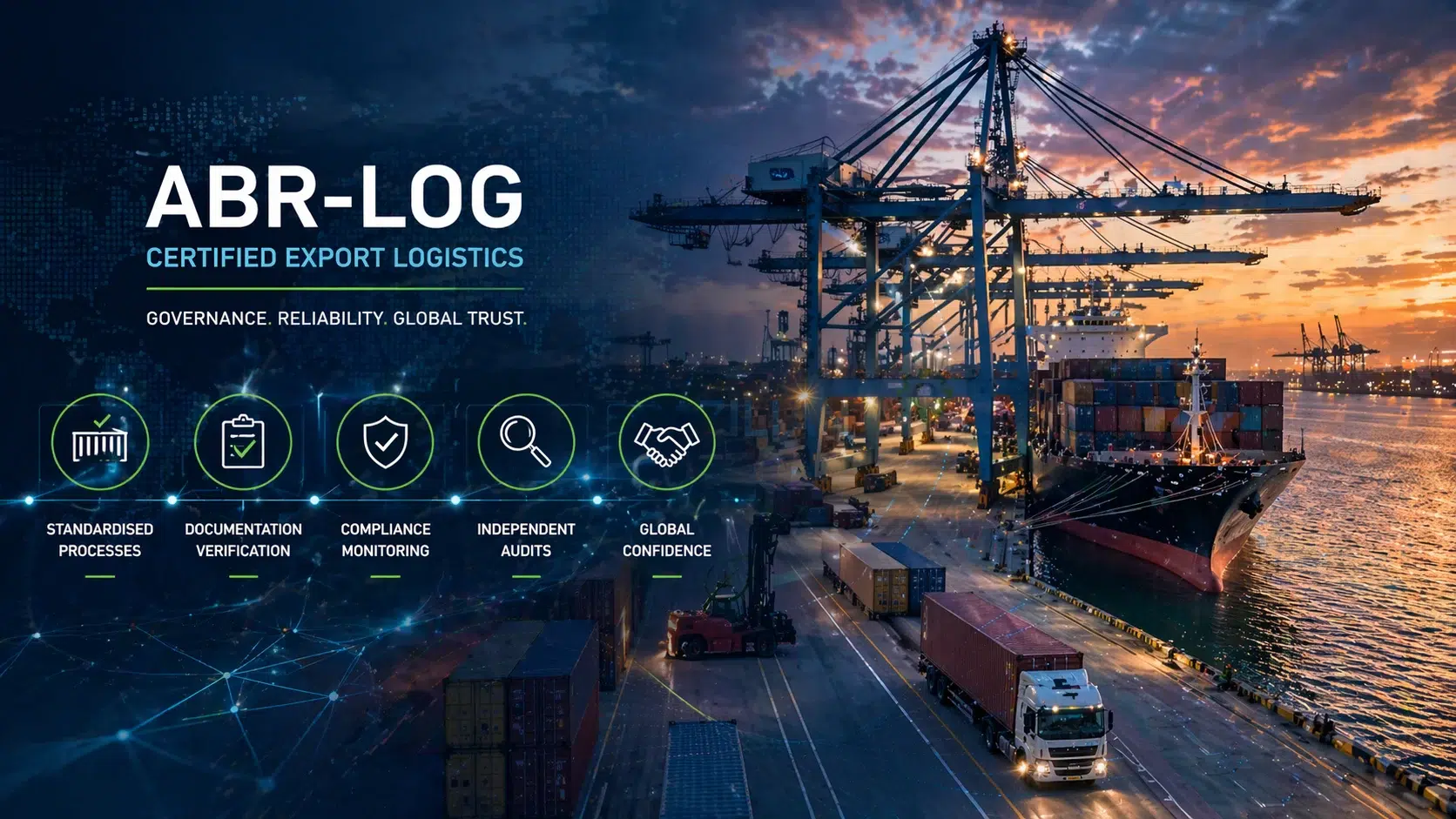
ABR-Log formalises standards and establishes defined protocols across certified terminals covering:
- Container stuffing methodology
- Bale storage and handling discipline
- Documentation validation and verification
- Compliance monitoring
- Independent third-party audits
By integrating these processes into a unified certification framework, the program ensures that the discipline applied upstream in production is preserved during export execution. The program introduces structured oversight at a stage of the value chain that historically operated with varying degrees of procedural uniformity. The result is reduced variability and greater predictability in shipment handling.
Adoption and Current Coverage
In the 2023/24 commercial season, ABR-Log certified terminals handled approximately 42% of Brazil’s total cotton export volume. For a logistics certification initiative still in its early expansion phase, this represents substantial penetration and industry endorsement.
Certification is concentrated in key export hubs, notably Santos and Salvador, which together manage a significant share of outbound shipments. The concentration within high-volume nodes creates a scalable platform for further expansion across the national logistics network.
Performance and Market Confidence
As Brazil’s export share increased, predictability and documentation accuracy became increasingly material to international buyers. Structured port-level governance contributes directly to greater uniformity in container loading, enhanced bale integrity control, consistent documentation validation, and improved coordination between exporters and inspection agencies.
For importing markets such as Turkey, Bangladesh, Vietnam, and China, these elements translate into clearer shipment visibility and improved planning confidence. While fibre parameters remain fundamental to sourcing decisions, execution reliability increasingly influences origin preference in large-volume contracts.
The 2026 Roadmap
The next phase of ABR-Log is built on calibrated expansion and deeper integration across systems.
- Expansion of Certified Terminal Coverage: Increasing the proportion of exports routed through certified terminals to establish broader uniformity across Brazil’s logistics infrastructure.
- Digital Integration and Data Alignment: Strengthening connectivity between bale traceability systems, inspection documentation, and export data flows to improve transparency and real-time coordination.
- Performance Benchmarking: Embedding measurable operational indicators to drive continuous improvement in loading consistency, documentation precision, and audit performance.
- Governance Continuity at Scale: Ensuring third-party oversight mechanisms expand in parallel with certification coverage to preserve program integrity.
The emphasis remains on disciplined scaling, where governance strength keeps pace with export growth.
Conclusion
Brazil’s cotton export architecture has evolved from a production-centric model into a fully integrated governance framework. With over four-fifths of national output under ABR production certification and nearly half of exports already managed through ABR-Log certified terminals, structured standards now extend across both production and logistics stages.
ABR-Log represents the formalisation of export reliability as a national competitive asset. For global spinners and traders, the implication is straightforward: Brazilian cotton is supported not only by quality and sustainability, but by an increasingly systematised and auditable export logistics framework aligned with long-term trade stability.
To know more, write to us on support@cottonbrazil.com