
Brazilian cotton has steadily strengthened its position in global markets through scale and sustainability and a consistent and measurable improvement in fiber quality. The 2024/25 crop reflects this progression, supported by structured measurement systems, improved agronomy, and continuous engagement with spinning mills worldwide.
As spinning operations become more precise and quality-driven, fiber consistency and predictability play a central role in sourcing decisions. Brazil’s cotton ecosystem has evolved to meet these expectations through a systematic approach.
A Data-Driven Quality System
Cotton is tested at the bale level through the Standard Brasil HVI (SBRHVI) program, with accredited laboratories operating under a centrally monitored framework. This ensures consistent measurement across regions and comparability across seasons.
For international buyers, this system delivers reliable and transparent data, enabling more informed sourcing decisions. For mills, this translates into more predictable fiber behaviour and processing outcomes.
The 2024/25 Crop: Strengthening an Established Baseline
The 2024/25 crop demonstrates a clear strengthening of core fiber characteristics. Parameters such as length, strength, uniformity, and micronaire place more than 90% of the crop within premium ranges.
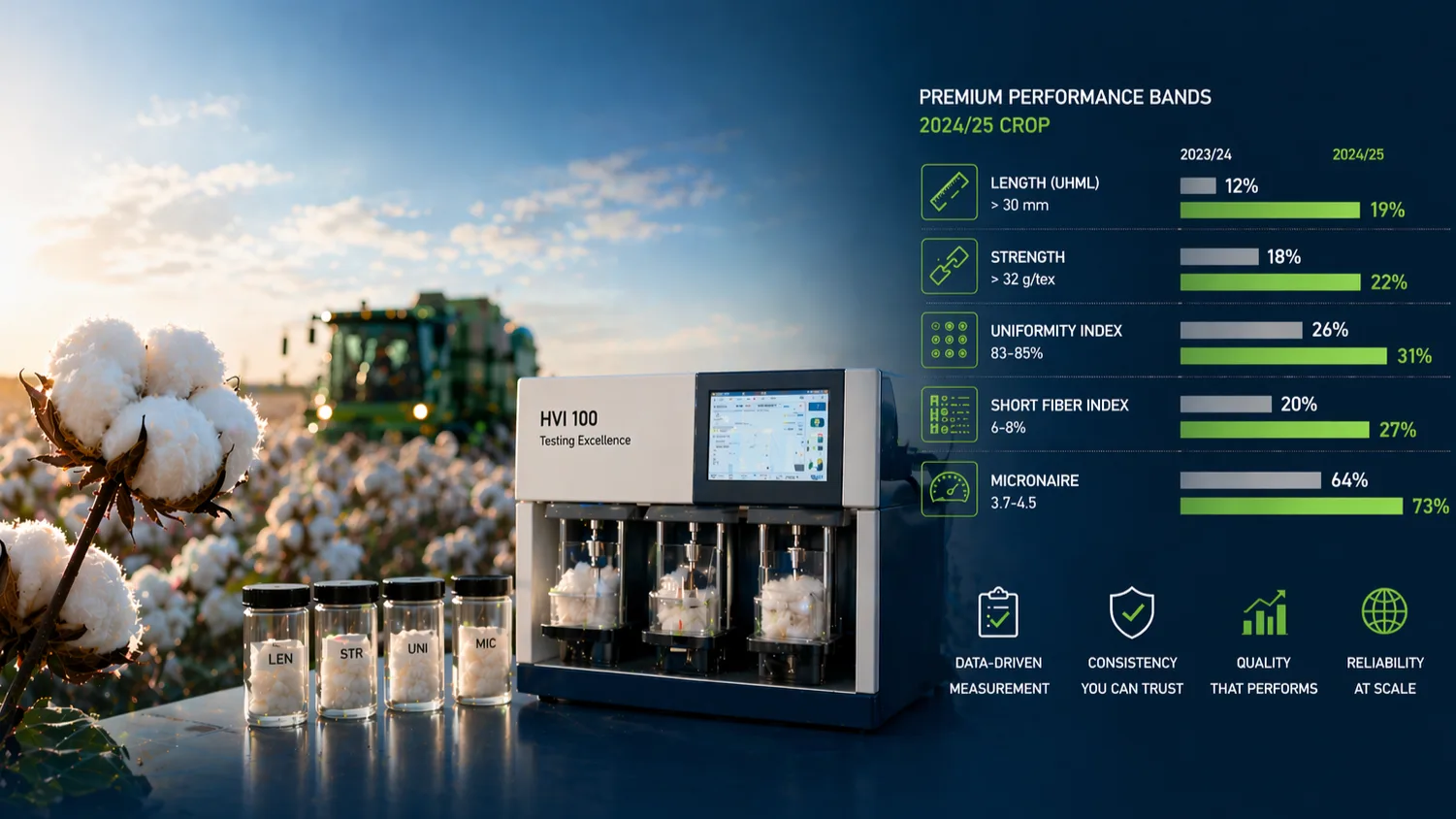
A comparative snapshot of key fiber characteristics within premium performance bands is presented below:
| Parameter | 2023/24 Crop | 2024/25 Crop |
| Length (UHML) > 30 mm | 12% | 19% |
| Strength > 32 g/tex | 18% | 22% |
| Uniformity Index in range 83-85% | 26% | 31% |
| Short Fiber Index in range 6-8% | 20% | 27% |
| Micronaire in range 3.7-4.5 | 64% | 73% |
Detailed quality reports and crop-wise analysis can be accessed here: [Cotton Brazil Quality Reports]
The 2023/24 crop had already established a strong benchmark across key parameters. The current crop builds on this base through incremental and well-distributed improvements. The shift is most visible in higher concentration within premium bands, particularly in length, strength, and micronaire distribution.
Aligning Fiber Quality with Mill Performance
Spinning mills evaluate cotton beyond laboratory parameters, with increasing focus on processing behaviour and operational stability. Areas such as seed coat fragments and stickiness continue to be part of industry discussions, as they influence mill efficiency.
These aspects are closely linked to harvesting practices, ginning processes, and environmental conditions. ABRAPA has strengthened its engagement across these areas through targeted workshops, technical interventions, and continuous interaction with producers and ginners.
At the same time, feedback from spinning mills is actively integrated into the system. Mill trials and international feedback provide practical insights into fiber performance, which are translated into improvements at the production and processing stages. This creates a direct connection between field practices and mill outcomes, strengthening consistency and reliability.
Conclusion
The 2024/25 crop reflects a system that continues to advance in precision, consistency, and alignment with market requirements. Quality improvement is embedded within a framework that combines measurement, feedback, and continuous refinement. For global spinners, this translates into a sourcing proposition that delivers both performance and reliability.
To know more, write to us on support@cottonbrazil.com